
By Marco Nektan, Originally written in Serbian and covers a rich exploration of goddesses across Old European and Balkan traditions:
Gods / Bogovi
Hecate
Hecate is the goddess of magic, witchcraft, night, the moon, ghosts, and necromancy. According to post-Olympian Greek legend, she was the daughter of the Titans Perseus and Asteria, from whom she inherited power over the sky, the earth, and the barren sea. In one legend, Hecate assists Demeter in her search for her daughter Persephone, carrying burning torches. After the reunion of mother and daughter, she became Persephone’s escort back to the underworld — which again makes her the goddess of burning torches, light in the darkness, goddess of stars and fire. She is also the goddess of gates, doorways, and thresholds, bearer of keys to all locks, of knowledge of healing herbs; she is the Mistress of earth, sea, sky and the underworld, and holds the universal role of Savioress, Mother of Angels, and the Cosmic Universal Soul.
Her name Hecate is of Greek origin (although the cult of this goddess is much older, dating back to the Paleolithic) and means “worker from afar.” She is venerated by many peoples under many different names.
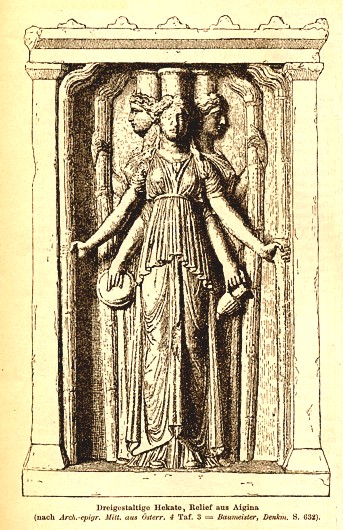
In ancient Greek art she is depicted as a woman holding two torches. Sometimes she is dressed in a short skirt with hunting boots and resembles Artemis (some anthropologists consider Artemis one of Hecate’s equivalents, given that their cults are very close). She is very often depicted in triple form, since she is the goddess of crossroads.
Hecate is identified with various other goddesses and is known by many other names: Artemis and Selene as goddess of the moon; in Arcadia she was worshipped as Despoina — Demeter’s second daughter — goddess of fertility celebrated in the mysteries; the sea goddess Crataeis or Ceto; worshipped as a goddess of the Scythians; as the Colchian nymph Perseis — beloved of Helios, who bore him two witch-daughters and one magical king; Argive Iphigenia; Thracian Bendis and Cotys (identified with Phrygian Cybele); Euboean Maira — the star Sirius; Eleusinian Daeira — a Nereid, Oceanid, and Nymph whose name means “teacher”; Boeotian nymph Hercyna.
Her sacred animals are: weasels and ferrets, dogs and wolves (especially black ones), frogs, cows, horses, and serpents.
The Cult of Hecate:
Hecate is fundamentally the goddess of witchcraft, night, the dark moon, ghosts, necromancy, and crossroads. She had a few well-known public temples in the ancient world, but many household shrines were erected to protect homes and their inhabitants. The most famous cults were celebrated in the Eleusinian and Samothracian Mysteries.
Cult sites: household shrines, crossroads shrines, cults in Attica — Athens, Eleusis, the great temple at Aegina (southern Greece), Sicyonia (southern Greece), Argolis (southern Greece), Thessaly (northern Greece), in Thrace (between the old mountain and the Struma river), the mountain and cave of Samothrace (where she was worshipped as Zerintia), cult on Delos (Aegean Macedonia), cult on Rhodes (Aegean Macedonia), cult in Ephesus and Colophon (Turkey), cult in Lagina (Turkey), cult in Paphlagonia (Turkey), cult in Sicily (Italy), cult in Delphi (Greece).
Her cult titles:
- Perseis — she who destroys; daughter of Perses
- Brimo — she who is terrible, furious
- Aedonaea — Lady of the Underworld
- Trimorphos — triple-formed
- Trioditis — Lady of the Crossroads, of three roads
- Enodia — Lady of the Roads
- Zeritia — venerated in Samothrace
Her shrine was called the Hekataion.
Poetic titles and epithets:
- Nyktipolos — Night wanderer
- Atalos — Delicate
- Chthonia — of the earth, of the underworld
- Kourotrophos — nurturer of the young
- Skylakagetis — leader of dogs, wolves, Alpha She-Wolf
- Core munagenes — self-born maiden
- Liparokredemnos — under a bright veil
- Anassa eneri — queen of the dead
Additional epithets:
- Angelos — Artemis Angelos is considered by some to be her original name; as goddess of the moon, this cult reveals her connection to Thracian Bendis; Mother of Angels
- Brimo — terrible, furious — here she merges in cult with the chthonic Persephone
- Feraea — another epithet linking this goddess with Artemis
- Phosphorus — Goddess of Light, once again identified with Artemis (Diana Lucifera) and Eos
- Soteira — Savioress, universal cosmic soul
- Populaia — she who stands at doorways and gates
- Kleidouchos — she who carries keys to all locks
- Apotropaia — she who protects and transforms
- Trivia — her Roman name
Hecate and Other Goddesses
Her triple nature can be interpreted through her epithets of dominion over the worlds (Soteira), the earth (Cybele), the underworld (Chthonia), and the sky — moon and stars (Artemis Phosphorus). In this threefold nature, Graves saw her shifting triple state (Maiden, Mother, and Crone), although fundamentally these three goddesses do not carry those epithets.
Goddess of Earth and Fertility (Cybele, Despoina, Artemis)
Thracian Cotys:
A Thracian goddess worshipped in the wilderness within the context of Bacchanalia. She was similar to, if not the same as, the goddess Bendis (where we later see the link between Cybele and Hecate).
Cotus or Cotytto is a Thracian deity whose festival, the Cotyttia, resembles the celebration of Phrygian Cybele, celebrated on the hills in wild processions. In a later period her worship spread into the Greek world and was associated with the Dionysian Mysteries. Her cult extended even to Italy and Sicily. Those who celebrated her mysteries were called baptai, a name connected with a ritual purification in water associated with her festival.
Phrygian Cybele:
The Thracian goddess Cybele was most widely celebrated in Asia Minor, but traces of her cult are also found in the Balkans, with a long history going back to the Paleolithic. Cybele, Kebela, Kuvava, Kubaba (some anthropologists derive from this name the name of the Slavic Baba, Baba Yaga), Matar Kubileia — Mountain Mother, Mountain Goddess Mother. An Old European cult from before the Indo-European migrations. She was depicted as a woman seated on a throne flanked by two lions — a depiction that is compared to other enthroned goddesses found in the Balkans from the Neolithic period. She was also compared to Mother Earth Gaia, Minoan Rhea, and the Grain Mother goddess Demeter. She was celebrated as an exotic goddess in secret mysteries accompanied by wild music, wine, and ecstatic dances. Unique in the Greek world, she had transvestite priests, or eunuch priests — probably because of her beloved Attis, who in her honor sacrifices his own manhood. She was worshipped as the goddess of mountains, cities, and city walls, of fertile nature and wild animals. In Rome she was celebrated as Magna Mater — the Great Mother.
She was celebrated in the Samothracian Mysteries as the chief deity, Axieros, and in the Lemnian Mysteries as Rhea-Hecate (where we see her connection with Hecate). Given the antiquity of this cult, it can be concluded that the cult of Cybele — or Thracian Cotys — preceded the worship of Dionysus and the cults that came after him. Another legend says she is the mother of Sabazios, the great Thracian god. Because no original name has been found, she is also called the Great Mother on the Throne, corresponding to her statues.
Symbols and attributes:
- Lions and chariots (the goddess in a chariot was found in the Starčevo culture)
- Scepter — as a symbol of the queen, mother of the gods
- Crown — Cybele wears a crown in all ancient statues, another epithet of the queen
- Black multi-layered garment — she was sometimes depicted in black layered clothing as a symbol of the fullness of the earth
- Cymbals are sacred to the goddess
- Sacred places are mountain peaks
Sacred animals and plants:
- Hawk and Lion
- Silver Fir
Companions of the Goddess:
- Attis — sacrificial deity, beloved of the goddess
- Pan — goat-footed god of forest and fertility, companion of the goddess, her brother
- Sabazios — proto-Dionysian cult, Thracian horseman, son of Cybele
One important fact is that this goddess was worshipped by the Triballi as the mother of Dionysus, though under a different name. The old mountain itself is called Balkan, whose name comes from the old Celtic Bal Kan — Great Mother, representing the great Throne of the Great Mother Goddess — Cybele, at whose foothills the Triballi lived.
Goddess Despoina (Despiona):
She is a goddess of Greek mythology whose name means the ruling goddess or mistress, and is also an epithet of Aphrodite, Demeter, and Persephone.
She was the daughter of Poseidon and Demeter, and in the Arcadian mystery cult she was venerated as a goddess of fertility, like her mother. Her true name was revealed only during initiation. She also represents the bright Persephone and is equated with Hecate (from which we understand that Hecate is a daughter of Cybele). The cult of Despoina in Arcadia consisted of an altar and statues of her and her mother seated on a throne (yet another similarity with Cybele).
Artemis:
She is the great Olympian goddess of the hunt, wilderness, and wild animals. She is the goddess of childbirth and protectress of girls until their wedding. Her twin brother was Apollo, protector of boys. Together they are gods who bring unexpected death and disease — Artemis strikes girls and women, Apollo boys and men.
She is the goddess of wilderness, animals, and the hunt; goddess of forest fires; goddess of lakes and springs; goddess of fishing; goddess of wild roads; goddess of morning and frost; goddess of childbirth, children, and babies; goddess of maidenhood and marriage; goddess of dance and music; goddess of disease and death; goddess of healing and good health; goddess of ritual purification; goddess of ancestors and heritage; goddess of the Amazons; goddess of the Hyperboreans; goddess of the Moon — identified with Selene; identified with Hecate as companion of Persephone, but also through many other epithets; the Triad: Hecate–Artemis–Selene; identified with Despoina; identified with Thracian Bendis, Egyptian Bastet…
Symbols and Attributes: Chariot and deer; bow and arrow as symbols of the moon; hunting spear; lyre, pan flutes; torch.
Sacred Animals: Bear, boar, deer, river fish, hawk.
Divine Companions: Apollo, Persephone.
Cult of Artemis: The month sacred to Artemis is May — Artemision, celebrated in Thrace. Cults existed across Greece, Turkey, the Black Sea region, Sicily, Italy, Gaul (France), and Iberia (Spain).
Cult Titles (selected): Agrotera — huntress; Diktynaia — of the hunting net; Daphnaea — of the laurel tree; Elapheios — of the deer; Lykaios — of wolves; Limnaia — of the lake; Eurynome — goddess of creation, of shores; Paedotrophos — nurturer of the young; Orseilocheia — she who aids in childbirth; Phosphorus — she who brings light; Soteira — Savioress; Potnia Theron — Queen of Beasts; Hagne — pure; Parthenos — maiden, virgin.
Her temple was called the Artemiseum.
Thracian Bendis:
Bendis or Bendidea was a Thracian goddess of the moon and the hunt, worshipped in Bacchanalian orgiastic mysteries in the wilds of Thrace. The Greeks identified her with Artemis, Hecate, and Selene (the Moon); she is closely connected with Cotys. In art she was depicted with the attributes of Artemis or Hecate. She may be a remnant of the proto-cult of Artemis and Hecate.
The Forest Mother:
The Forest Mother is found among other peoples as well; it can be assumed that this figure is a relic of Paleolithic culture, as Forest Mothers appear in nearly all Paleolithic peoples. This figure also points to a pronounced matriarchy, which was later replaced by patriarchy but remained very strong among the Serbs. This type of being also indicates a deep connection between the Serbs and the forest, which was in fact a sacred place. When there was no shrine, rituals were performed in forests, and the Forest Mother was the mistress of the forests and guardian of that sacred place.
The Forest Mother was imagined as a very beautiful woman with full breasts, long flowing hair, and long nails. The full breasts indicate fertility, a feature of all demons and deities connected with fertility. It was believed she lived in the forest and could dwell in the treetops. She roamed the forest either naked or clothed in a long white dress. She could also appear as an ugly old woman, but still with large breasts and prominent teeth. She could transform into a haystack, a bundle of hay, a turkey, a cow, a pig, a dog, a horse, or a goat. She appears only at night, and when encountering humans, she does not wish to cause harm. She often seduced mortal men — the motif of supernatural beings having relations with mortals appears in almost all such traditions.
One recorded story tells of a miller who claims to have found a beautiful naked woman with large breasts in his mill at night, who gave herself to him. He then says he saw her in the treetops.
The Forest Mother was the mistress of the forests — when she walked through the forest, the trees bent down to the ground. She was believed to sing beautifully. She was also considered a protectress of pregnant women and newborns, though she could also attack them by bringing illness to children. But she was also petitioned for help when it came to children’s ailments. In healing incantations for children she is frequently mentioned, and from these texts it emerges that she both brings and takes away disease. There was also a plant called “Forest Mother,” which was believed, when burned as incense, to enable barren women to conceive. It could be found in spring beside mountain streams, before the cuckoo first called. A woman who went searching for this plant was not allowed to speak, and had to be ritually pure — in clean clothes and having abstained from sexual relations beforehand. This plant may have been another form of the Forest Mother herself.
Among the Banat Hera people, this mythic being was called the Mountain Mother. Their curse was: “May the Mountain Mother take you.” Near the Đerdap gorge, this being was called Šumenka. The Šumenka could appear as either a beautiful or an ugly woman — as beautiful she caused no harm, but as ugly she carried a magic wand with which she did evil to people (she was also imagined similarly to a witch, and in that region the Forest Mother seems to have absorbed both roles). The Bulgarians knew of the Mountain Mother. The Vlachs call her Muma Pădurii.
It is reasonable to assume that the Forest Mother was once a goddess, as she shares many characteristics with the goddesses of classical mythologies. In some features she resembles Hecate and Artemis. The fact that the Forest Mother could be a divinity before she became a demon is also confirmed by the fact that nearly all Neolithic civilizations believed in a deity with similar characteristics. This being is therefore probably older than the religion of the Indo-Europeans itself, or represents the beginning of their religion.
The Vila Samodiva:
The Samodiva closely resembles — or may be identical to — the Forest Mother. She is often believed to exist in multiples, and this tree deity is identified with vilas (spirits of nature). The root of this cult is not found in Slavic religion but derives from much older cults.
The Vila Samodiva had many names and is an epithet of Artemis or Hecate in Balkan folklore. She is the companion of Marko Kraljevič, or Sabazios in folkloric form. According to some legends, the Samodiva nursed Marko Kraljevič, and because of the magical powers of her milk he became an invincible hero.
Samothracian Zerintia:
Hecate appears in the Samothracian mystery cult under the name Zerintia and as Aphrodite-Zerintia (two goddesses), equally beloved and celebrated, though distinguished from the Great Mother goddess. They can be compared to Artemis and Persephone, or Despoina and Persephone. Their cult predates the Indo-European period and proves the antiquity of the Samothracian Mysteries.
Goddess of Life, Death, and Rebirth:
An ancient Neolithic goddess, from whose cult the cult of Hecate arose — she was the cosmic goddess, the snake goddess or bird goddess, the egg-shaped goddess — the primordial source of all, mother of creation, goddess of fertility and regeneration, goddess of the moon, nurturer, horned sacrificial goddess…
On Minoan Crete she appears as a Priestess holding two snakes, and the Pelasgian creation myth mentions the goddess Eurynome, whose myth was later adopted by the Orphic cult. She can be identified here with the egg-shaped goddess.
The Ancient Goddess Eurynome:
According to the Pelasgian creation myth, she is the Creatrix, Goddess of all living things. The legend says she appeared naked from primordial chaos, to separate the ancient ocean from the heavens, and danced upon the waves. Catching the north wind at her back and rubbing it between her fingers, she warmed the breath and spontaneously created the great serpent Ophion (Phanes, Primal Eros, Ouroboros), who mated with her. In the form of a dove flying over the waves, she laid the cosmic egg and placed Ophion to incubate it by coiling around it seven times, until the egg split in two and from it emerged everything that now exists — the sun, moon, planets, stars, the earth with its hills and mountains, rivers and lakes, trees and plants, and all other living beings.
This goddess is identified with the goddess of regeneration from the Neolithic period, since this legend originates there, and as such belongs to the epithet of Proto-Hecate.
Goddess Serbona:
(The following section is drawn from an internet source and represents a folk-nationalist interpretation unique to Serbian mythological writing. It contains speculative and contested claims.)
SERBONA was considered the greatest goddess of the ancient world, most widely worshipped by the Serbs, Greeks, and Romans. She had many names, and each of these peoples celebrated her under their own distinct name. Her male divine counterpart is the god SERBON, one of the supreme gods among the Serbs and a deity protecting the ruling and warrior classes. This divine pair represented the main characteristics of day and night — Serbon representing the Sun, Serbona representing the Moon.
The chief role of the goddess Serbona is the protection of life and fertility of all in nature. The people called upon her as mother, midwife, and nurse. She regulates the hunting of wild animals. To protect the game, she shoots the god of hunters, Arion, with her arrows.
The symbol of goddess Serbona is a cross with four “ocila” (firesteels), which are in fact four crescent moons symbolizing her cosmic role. That sign remained as the main symbol of the Serbian coat of arms.
(Text continues in similar nationalist-mythological vein, equating Serbona with Artemis, Diana, and Hecate across the ancient world.)
Hidden in the Form of Saint Petka:
The folkloric attributes of this Christian saint almost entirely correspond with the cult of the ancient goddess Hecate. The reason is precisely the love that the people had for this goddess and their knowledge of her power — they simply draped her in a new veil, but the essence remained the same. A woman in a black cloak and veil like the night — black is Hecate’s color. Holy springs dedicated to Saint Petka — once sacred sites; Hecate is both the goddess of death and a healer and goddess of waters. Saint Petka is protectress of women and small children — likewise Artemis (who is fully identified with Hecate) is protectress of women and children. Most widely venerated among the Thracians, from the Balkans to Asia Minor — Hecate’s cult among Thracian tribes included the Triballi, Moesi, Illyrians, Samothracians, and Phrygians. Hecate certainly had an important place alongside Cybele. Saint Petka, by hagiography, was a Thracian born in Asia Minor near Constantinople (near Constantinople stood one of the greatest temples of Hecate — at Lagina). Saint Petka is celebrated on October 27 by the new calendar — October 31 — the end of October and beginning of November is considered the end of the harvest year, when days grow darker and colder; it is believed that the dead walk the earth, and this is Hecate’s season until the winter solstice, as Hecate herself is the mistress of the dead, of spirits, and of the dark time of year.
Finally, Why Hecate Is a Serbian Goddess:
- Evidence of her cult is found in legends of the Vilas, the Samodiva, the Forest Mother, hidden in the figure of Saint Petka, in the remains of cult and idols of the Vinča and Starčevo cultures, and according to some claims, in the name Serbona.
- As goddess of crossroads — Serbia is the crossroads of many roads, from north to south and east to west, a crossroads of cultures, languages, religions, and nations; Serbia is the heart of the Balkans and the Balkans are the gateway to Europe; Hecate stands at the gate and holds the keys.
- As Artemis the protectress of Wolves — Serbs are the Wolf People.
- The cross with 4 C’s — 4 phases of the moon — Hecate is Goddess of the Moon.
- In Serbia for every 10 women there is 1 man — though a patriarchal country at base, the culture clearly shows remnants of matriarchal society, of which she, Hecate, is also the Protectress.
- She is known by countless names — Serbia has often changed names, as have its cities, language, and cultural markers.
In the end, the true name of this goddess can only be revealed to the initiated, and only they may invoke her by that name.
That’s the complete translation! It’s a rich, syncretic piece blending ancient Greek/Thracian mythological research with Balkan folk traditions and South Slavic nationalist mythology. The most scholarly sections are the Hecate epithets and the Cybele/Artemis material; the Serbona section reflects a more speculative/nationalist folk-mythology tradition common in Serbian esoteric writing.


