Not just a Weed … you’ve probably heard your whole life about the need to get rid of ‘weeds’ to have that perfect lawn. Did you know how damaging that perfect lawn is to Mama Earth? Join us for the other side of ‘Our Story’ as we look at some common weeds.
*Picture from Facebook group Foraging for Wild Plants, Mushrooms Hedgewitchery Herbs
Yellow dock is often found in disturbed soils, roadsides, fields, and gardens. It is considered a weed in many places but is valued by herbalists for its medicinal properties.
Yellow dock is a common name for several species in the Rumex genus, most notably Rumex crispus (curly dock or curly leaf dock). It is a perennial herbaceous plant native to Europe and Western Asia but now widespread in North America and many other parts of the world.
Description
- Leaves: Long, narrow, wavy or curly-edged leaves (hence “curly dock”).
- Stems: Tall, slender, and can reach up to 1–1.5 meters (3–5 feet).
- Flowers: Small, greenish-yellow flowers that grow in clusters on tall stalks, turning reddish-brown as they mature.
- Roots: The root is thick, yellowish-brown on the outside and bright yellow inside, which is where the name “yellow dock” comes from.
Uses
Yellow dock has a long history of use in herbal medicine:
- Digestive Health: Traditionally used as a gentle laxative and to support liver and gallbladder function.
- Blood Cleanser: Considered a “blood purifier” in folk medicine.
- Skin Conditions: Used topically or internally for skin issues like eczema, psoriasis, and acne.
- Iron Content: Sometimes used as a source of plant-based iron, especially in herbal formulas for anemia.
Preparation
- Root: The root is the most commonly used part, harvested in the fall, dried, and used in teas, tinctures, or capsules.
- Leaves: Young leaves can be eaten as a cooked green (they are high in oxalates, so should be cooked and eaten in moderation).
Cautions
- Oxalates: Both leaves and roots contain oxalates, which can be problematic for people prone to kidney stones.
- Laxative Effect: Overuse can cause diarrhea or digestive upset.
Source: Midwest Women’s Herbal see video below and be sure to check out their Annual Conference and other Offerings!
Note: While yellow dock is generally safe in small amounts, always use caution and consult reliable sources before ingesting or using any herb medicinally.
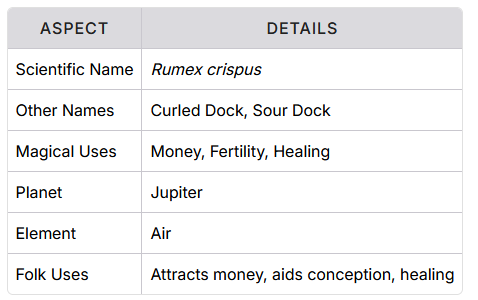
Magical Uses:
- Money Spells: The seeds and powder are commonly used in money spells and incenses. They can also be sprinkled around a place of business to attract customers.
- Fertility: Tying the seeds to the left arm of a woman is said to help her conceive a child.
- Incense: Used in money-drawing incenses.
- Divination: Sometimes used in divination rituals.
Magical uses from Cunningham’s Encyclopedia of Magical Herbs and Norse Magic.
Note: While yellow dock is generally safe in small amounts, always use caution and consult reliable sources before ingesting or using any herb medicinally.
Use Hinneh! the divine feminine library to ask how to do the money spell … one of the benefits of membership with the divine feminine app community …

This post is part of Goddess 101 Texts – telling another side of Our Story.
Text ‘Join’ to 256-815-0760 to get your free daily dose of inspiration. *text Stop to stop at any time. Consent.
#Goddess101Texts a daily wake up call from Ancient Mother.

Use QR code above to text ‘Join’ plus your email to 256.815.0760 (Sorry for now, US only as International Texting is a thing, but you can see our monthly texts here and top right sign up to be notified of new blog posts from this site.)
Brought to you by the divine feminine app. Over ten years, the original source for finding Sacred Women Circles, events, retreats and resources. Sign up on the app to get a weekly email of Circles by you and online.