
Herstory
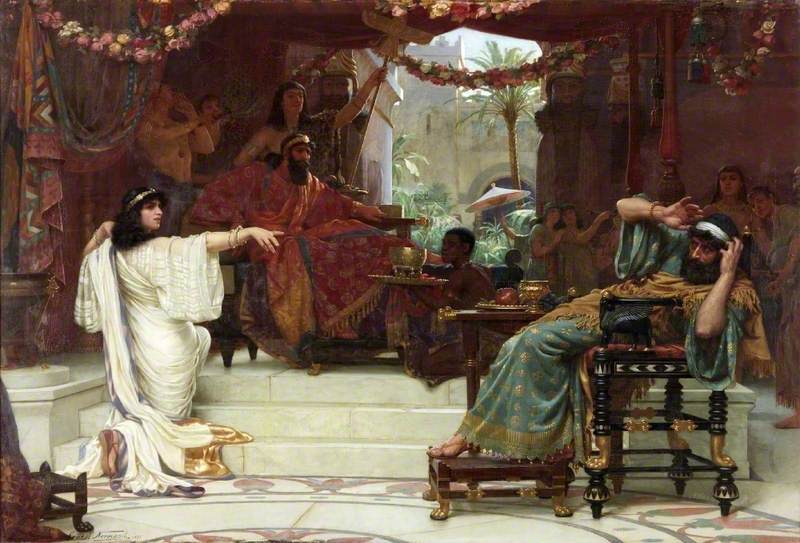
*Picture is of a painting by Ernest Normand in 1888 of Esther Denouncing Haman to King Ahasuerus. Yea, that’s right, you better cower.
The story of Esther is about risking all for that which matters: each other. Esther was the Jewish queen of Persia who, along with her cousin Mordecai, saved her people from a plot by the royal advisor Haman to destroy them, as recounted in the Book of Esther (Megillah).
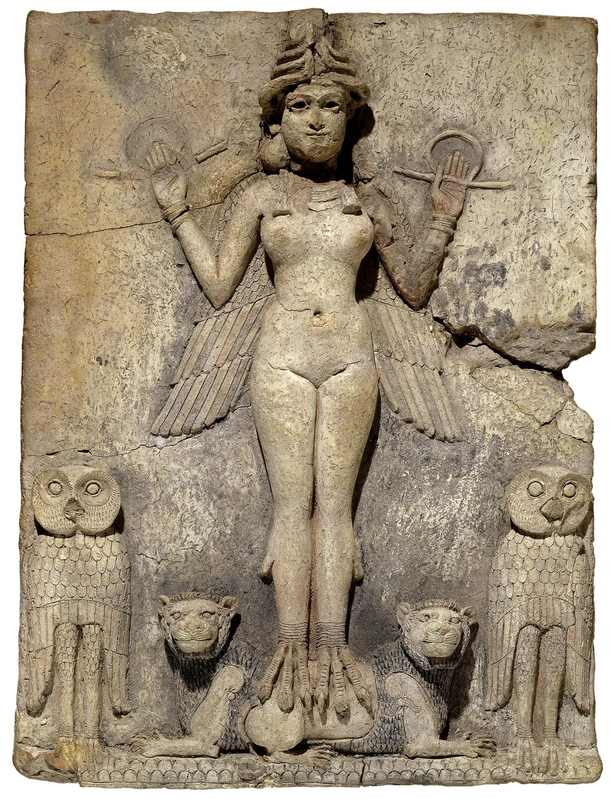
Esther is widely linked to Ishtar or the Sumerian Goddess Inanna, the great Babylonian goddesses of love and war. The ancient city of Babylon (ancient Babylonia in Mesopotamia) is located in modern day Iraq. Ancient Babylon reached its heights in the 16-18th centuries and the 7th-6th centuries BC (that is 2,600 to 3700 years ago!)
This popular picture of Ishtar circa. 20th – 16th century BCE (that’s 3,900 years ago) can be found in the British Museum.
The names ‘Esther’ and ‘Ishtar’ share a common Semitic root, and both figures share qualities: beauty, courage, the use of feminine power to intercede and save lives.
Purim, which was just celebrated (the 14th day of the Hebrew month of Adar) is one of the Jewish holidays with the most intriguing connections to ancient Near Eastern goddess traditions.
Esther’s story echoes the mythic structure of Ishtar in several ways. Ishtar was known for descending into dangerous places and using her power to rescue — in her most famous myth, she descends into the underworld to reclaim what was lost. Esther similarly “descends” into the dangerous royal court to rescue her people. Both figures embody the archetype of the hidden power of the feminine revealed at a moment of crisis.
But let’s step it back a bit: Vashti as the Shadow Goddess
Before Esther, Vashti was the Queen of Persia and the first wife of King Ahasuerus (Xerxes I) in the Book of Esther. She defied the king’s order to parade her beauty before his drunken guests. Due to her refusal, she was banished as queen and replaced by Esther. Some goddess spirituality scholars, like Barbara Black Koltuv and others in the feminist theology movement, highlight Vashti as equally important — she who refuses to be displayed, who holds her ground, and who is exiled.
Vashti and Esther represent two faces of the goddess: the sovereign, untameable feminine (Vashti) and the strategically empowered feminine (Esther).
The Festival Structure
Purim’s character — feasting, role reversals, costumes, intoxication, raucous celebration — echoes ancient Near Eastern fertility festivals and new year celebrations in which normal social order was temporarily upended. The Babylonian Akitu festival had similar features, including the ritual humiliation of a king figure (paralleling Haman) and the honoring of the divine.
Lots and Fate
The word Purim means “lots” (as in casting lots), referring to how Haman chose the date to destroy the Jews. The casting of lots to determine fate was a deeply embedded practice in ancient goddess religion, where priestesses of figures like Ishtar served as oracles and fate-diviners.
Feminist & Pagan Reclamations
Modern goddess spirituality practitioners — particularly in Jewish renewal, eco-feminist, and Wiccan-adjacent traditions — have embraced Purim as a holiday that honors:
- Female agency and courage (Esther)
- Feminine refusal and sovereignty (Vashti)
- The body, pleasure, and sensuality as sacred
- The trickster/shapeshifter archetype (costumes, hidden identity)
Scholars like Raphael Patai (The Hebrew Goddess) and writers in the Jewish feminist movement have done substantial work recovering these pre-monotheistic layers embedded in Jewish scripture and festival life.
Now Let’s Go Forward: relating these myths to present day:

Ivana Trump — The “Vashti” Parallel
- Strong personality and independence
- Public conflict during the divorce
- Refusal to remain quietly subordinate
- Ultimately removed from the central court (marriage)
In this symbolic reading, Ivana represents the assertive feminine that challenges patriarchal power.
Marla Maples — Transitional Figure
Marla Maples could be seen as a transitional archetype:
- Entered during upheaval.
- Relationship surrounded by scandal and spectacle.
- The marriage did not ultimately hold long-term power.
In mythic storytelling, transitional queens often appear between archetypal roles.
Melania Trump — The “Esther” Parallel
- Maintains a more reserved, strategic public presence.
- Exercises influence quietly rather than confrontationally.
- Navigates the court (politics, media, public life) with careful timing.
- This interpretation frames her as the strategic feminine within a powerful male court.
Ha! I know you are thinking how dare I compare Melania to Esther. But the story is yet to be done. And I have set this interesting postulation as an example of how we can see the world through mythic lenses.
Opens up all sorts of possibilities, doesn’t it?

This post is part of Goddess 101 Texts – telling another side of Our Story.
Text ‘Join’ to 256-815-0760 to get your free daily dose of inspiration. *text Stop to stop at any time. Consent.
#Goddess101Texts a daily wake up call from Ancient Mother.

Use QR code above to text ‘Join’ plus your email to 256.815.0760 (Sorry for now, US only as International Texting is a thing, but you can see our monthly texts here.)
Brought to you by the divine feminine app. Over ten years, the original source for finding Sacred Women Circles, events, retreats and resources. Sign up on the app to get a weekly email of Circles by you and online.


1 Comment