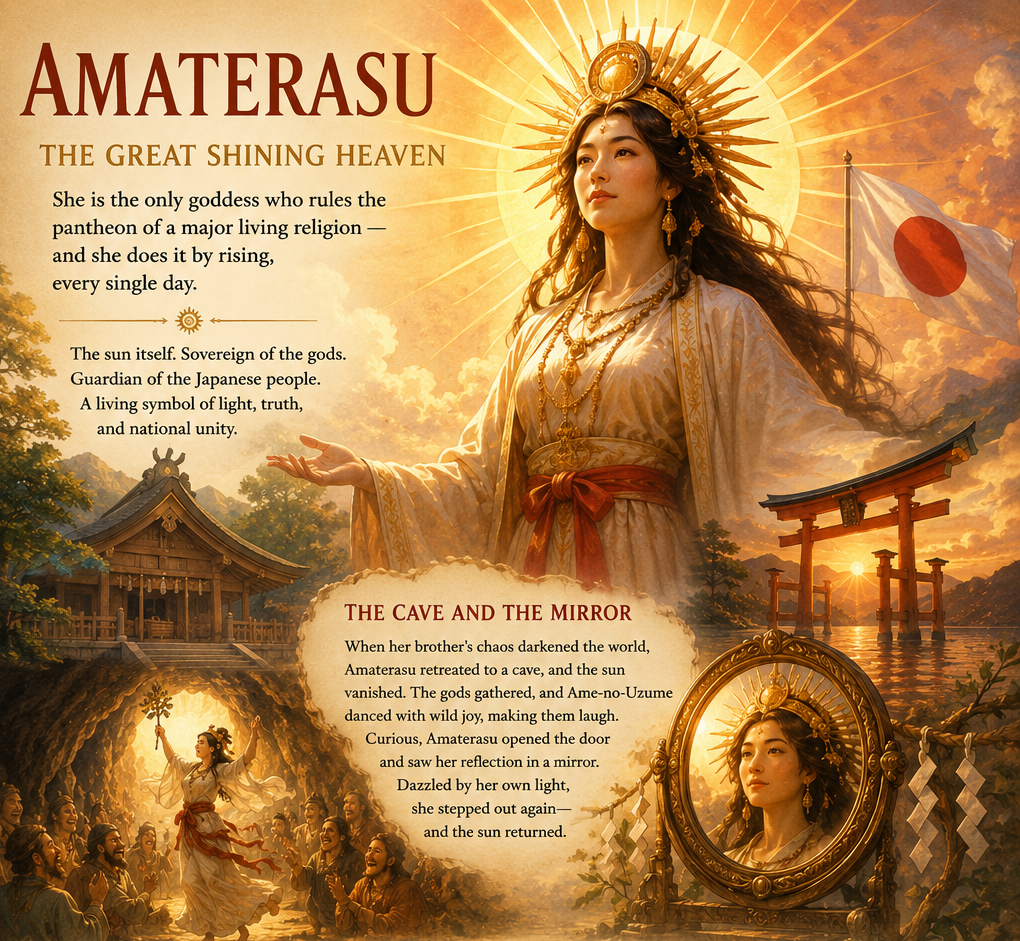
She is the only goddess who rules the pantheon of a major living religion — and she does it by rising, every single day.
In the vast tapestry of world mythology, sun deities have most often been portrayed as male — Ra, Apollo, Helios, Sol Invictus. But in Japan, the sun has always had a feminine face. Amaterasu-Ōmikami, whose name translates as Great Shining Heaven, is the supreme deity of Shinto, Japan’s indigenous spiritual tradition predating Buddhism by centuries. She is sovereign of the gods, guardian of the Japanese people, and a living symbol of national unity — her emblem, the rising red sun, emblazoned on Japan’s flag to this day.
She is, remarkably, the only goddess who stands as the chief divinity of a major world religion still practiced today. That alone makes her worth knowing.
She Is the Sun Itself
Amaterasu is not merely a goddess of the sun — she is the sun. In Shinto cosmology, she rules Takamagahara, the High Plain of Heaven, and it is her light that warms the earth, ripens the rice, and sustains all life. The Japanese imperial family traces its divine lineage directly to her, making her both a spiritual and ancestral mother to an entire civilization.
Her shrines are famously simple — nature-honoring spaces of wood and stone, many marked by a sacred mirror at their heart. That mirror is no ordinary object. It represents the goddess herself: radiant, pure, and reflective of truth.
The Cave and the Mirror: Her Central Myth
Every goddess has a story that reveals her depths, and Amaterasu’s is one of the most striking in world mythology.
Her brother, Susano-o, the storm god, was wild and grieving — weeping so violently for their mother that the seas raged and the mountains shook. His chaos became so destructive that Amaterasu withdrew in anger and sorrow, retreating into a great cave and sealing herself inside. With the sun goddess hidden, the world fell into darkness. Crops withered. Evil spirits ran unchecked. Winter came and would not leave.
The eight million deities of the Japanese pantheon gathered in council outside the cave, desperate to coax her out. They tried music, ritual, and prayer. Then the goddess Ame-no-Uzume began to dance — a wild, ecstatic, life-affirming dance that sent the gathered gods into uproarious laughter. Amaterasu, curious about what could possibly cause such joy in the midst of darkness, cracked open the cave door.
There, placed precisely where she would see it, hung a magnificent mirror.
Amaterasu looked — and was transfixed by her own reflection, dazzled by her own light. In that moment of wonder, she was gently drawn out, and the sun returned to the world.
The Mirror, the Necklace, the Sword
Amaterasu’s three sacred symbols speak to the full breadth of her nature, and they are kept as the most treasured regalia of Japan, enshrined at the Grand Shrine of Ise — one of the holiest sites in the Shinto world.
The Mirror (Yata no Kagami) is the most sacred of the three. It symbolizes purity and the capacity for self-reflection — seeing ourselves clearly, without illusion. In Shinto, the mirror is the face of the divine. To look honestly at yourself is to meet the goddess.
The Necklace (Yasakani no Magatama) connects Amaterasu to the ancient feminine arts of spinning and weaving. In her mythology, she presides over a sacred weaving hall, and the craft of cloth-making was considered holy work — threads binding heaven and earth, family and community, past and future. There is something deeply meaningful here for those of us who understand that feminine labor has always been sacred labor.
The Sword (Kusanagi-no-Tsurugi) reveals that Amaterasu is no passive sun. She is also a warrior, a defender of the people and the land. Her protectiveness has teeth. She is warmth and nourishment, yes — but also fierce boundary and righteous power.
Why She Matters to Us Now
For those of us walking a sacred feminine path, Amaterasu offers something profound: the image of a goddess who does not diminish herself for anyone’s comfort — and whose withdrawal reminds the world what it loses when feminine light goes dark.
Her cave story is not just myth. It is lived experience. How many of us have pulled our light inward, made ourselves small, hidden our radiance because the world felt too chaotic, too painful, too ungrateful? And how many of us know the moment of seeing our own reflection — truly seeing it — and remembering who we are?
Amaterasu came back. She always comes back.
Her shrines at Ise are rebuilt every twenty years, a ritual of renewal that has continued for over a millennium. Even the sacred spaces that hold her are not allowed to grow stagnant. They are torn down and recreated, exactly as before, so that the knowledge of how to honor her stays living — embodied, practiced, passed on.
This is the tradition she carries: not a relic, but a living flame.
An Invitation
If you feel called to work with Amaterasu, begin with the mirror. Find a quiet moment, look at your own reflection, and instead of cataloging what needs to be fixed — simply look. Let yourself be seen by yourself. Let the light in your eyes be sacred.
Then ask: Where have I been hiding in the cave? What would it feel like to step back into the warmth of my own radiance?
The eight million gods are dancing for you. The mirror is waiting.
✨ Ready to go deeper? The Divine Feminine App is a sanctuary for women walking the goddess path — with a community of 12,000 sisters, a living library of sacred wisdom, and daily inspiration to keep your light burning bright.
👉 Visit thedivinefeminineapp.com

This post has been done with the help of Hinneh BEHOLD! The divine feminine library – Her Magic at your fingertips. Hinneh is a member accessible feature of the divine feminine app.
This post is part of Goddess 101 Texts – telling another side of Our Story.
Text ‘Join’ to 256-815-0760 to get your free daily dose of inspiration. *text Stop to stop at any time. Consent.
#Goddess101Texts a daily wake up call from Ancient Mom.

Use QR code above to text ‘Join’ plus your email to 256.815.0760 (Sorry for now, US only as International Texting is a thing, but you can see our monthly texts here and top right sign up to be notified of new blog posts from this site.)
Brought to you by the divine feminine app. Over ten years, the original source for finding Sacred Women Circles, events, retreats and resources. Sign up on the app to get a weekly email of Circles by you and online.