

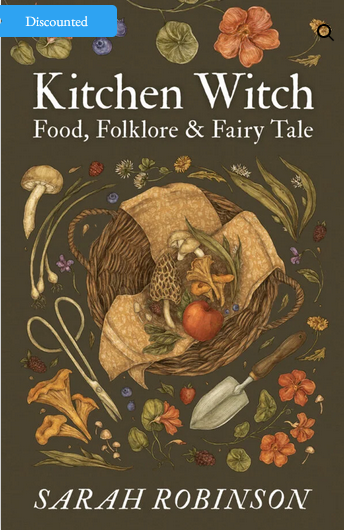
from Kitchen Witch: Food, Folklore and Fairy Tale
written by Sarah Robinson a Womancraft Publishing offering
*Picture credit Artistic Imaginings
Section Three: Food Medicine, Food Magic
Once, in every rural (and many an urban) home without access to a doctor (which was many), women were responsible for the healing, as well as nourishment, and care of both their family and animals. Women who have held no official titles, women who faced incredible challenges of raising children, feeding, cooking, preserving, weaving the best they could with the knowledge passed down to them, and for which they received little or no recognition. Grandmothers might divine fortunes, treat ailments, and create charms for healing. Midwives helped both bring new life in to the the world and lay out the dead. They held respected positions in an age when women otherwise had little status.
In medieval times, living conditions were poor and could be cut short by minor injuries, such as infections. Doctors were scarce and expensive, and early medicinal practices such as bloodletting and amputations could actually make things worse. For members of Europe’s lower classes, local healers were often the only option. They were highly respected, sought out and consulted for healing and for answers. In the British Isles, we knew these people as “cunning folk” – professional practitioners (both male and female) of folk magic from the medieval period onward who charged for their skills and services. They might also, depending on who you spoke to, be called, either by themselves or others -witches, pellars * , wise women, healers and magicians.
The history of folk medicine is entwined with myths, folk tales, fairy tales, and the homespun magic of these cunning folk. The cunning one was someone who would listen and offer magical practices and wise words to deal with all manner of everyday troubles, drawing from many practices and modalities. Each had their own areas of expertise, and they may well have used a mix of practices including spells, incantations, rituals, and skills in empathy and intuition. They were sought out to cure illness, find lost objects, and remove curses of malevolent forces imposed by witches or other supposed evildoers.
Wyrtcunning
In Old English “wyrtcunning” means plant knowledge. In Saxon times, someone skilled in wyrtcunning would be called on, just as a doctor is today.
Wyrt or wort, meaning a plant and its bounty, is still found in the common, country or folk names of many herbs and hedgerow plants: St. John’s wort, mugwort, bishop’s wort, dragonwort, liverwort, lungwort and bladderwort. These last three got their names from the shape of their leaves, rather than their curative properties … whereas birthwort, motherwort, feverwort and bruisewort got their names from their medicinal uses. Interestingly, wort is also the name for the sweet liquid extracted from the mash (ground malt and grain) process during the brewing of beer or whisky. Both uses of the word date back to before the twelfth century. Cunning meant a skill or knowledge, and you could liken it to to modern day areas of study: herbology or herbalism. This was very much everyday magic and healing. At this time, it wasn’t a case of whether people ‘believed’ in it, it was simply what was there, a trust in the land and nature.
*pellar – a Cornish term for witch.
𝓣𝓱𝓮 𝓕𝓸𝔁 𝓦𝓲𝓽𝓬𝓱
In a gothic cottage, dark and deep,
Where shadows dance, and secrets keep,
There dwells a witch of cunning sly,
With piercing gaze and wistful sigh.
She gathers potions from the night,
With purple flower, with mushroom bright,
In whispers soft, she chants her spell,
Beneath the moon, where secrets dwell.
A fox she is, in guise of night,
With eyes that gleam, with silver light,
In purple hue, her magic weaves,
Through ancient woods, where spirit grieves.
For purple holds her heart’s desire,
A hue that sets her soul on fire,
In every petal, every bloom,
Her ancient power finds its room.
Beware the fox witch, fierce and free,
In her domain, where shadows flee,
For in her hands, the world’s undone,
In purple dreams, her magic spun.
by Artistic Imaginings
Goddess Texts 101 are brought to you by the divine feminine app. Over ten years, the original source for finding Sacred Women Circles, events, retreats and resources. Sign up free, quick and easy to get a weekly email.

Use QR code above to text ‘Join’ plus your email to 256.815.0760 (Sorry for now, US only.)


1 Comment