
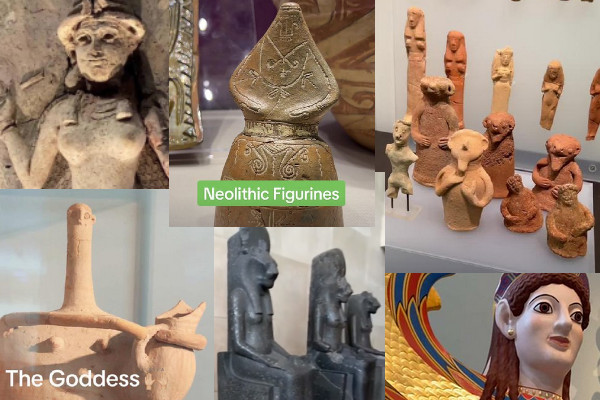
an excerpt from When God Was a Woman by Merlin Stone
[T]hat so many of the names used in diverse areas were simply various titles of the Great Goddess, epithets such as Queen of Heaven, Lady of the High Place, Celestial Ruler, Lady of the Universe, Sovereign of the Heavens, Lioness of the Sacred Assembly or simply Her Holiness. Often the name of the town or city was added, which made the name even more specific. We are not, however, confronting a confusing myriad of deities, but a variety of titles resulting from diverse languages and dialects, yet each referring to a most similar female divinity. Once gaining this broader and more overall view, it becomes evident that the female deity in the Near and Middle East was revered as Goddess – much as people today think of God.
In Strong and Garstang’s Syrian Goddess of 1913, some of the connections are explained. “Among the Babylonians and northern Semites, She was Ishtar; She is Ashtoreth of the Bible and the Astarte of Phoenicia. In Syria Her name was Athar and in Cilicia it had the form Ate (Atheh).”
In Robert Grave’s translation of the Golden Ass by the Roman writer Apuleius of the second century AD, the Goddess Herself appears and explains:
I am Nature, the universal Mother, mistress of all elements, primordial child of time, sovereign of all things spiritual, queen of the dead, queen also of the immortals, the single manifestation of all gods and goddesses that are. My nod governs the shing heights of Heaven, the wholesome sea breezes, the lamentable silences of the world below. Though I am worshipped in many aspects, known by countless names, and propitiated with all manner of different rites, yet the whole round earth venerates me.
The primeval Phrygians call me Pessinuntica, Mother of the gods; the Athenians sprung from their own soil, call me Cecropian Artemis; for the islanders of Cyprus I am Paphian Aphrodite, for the archers of Crete I am Dictynna; for the tri-lingual Silicians, Stygian Prosperine; and for the Eleusinians their ancient Mother of Corn. Some know me as Juno, some as Bellona of the Battles; others as Hecate, others again as Rhamnubia, but both races of Aethiopians, whose lands the morning sun first shines upon, and the Egyptians who excel in ancient learning and worship me with ceremonies proper to my godhead, call me by my true name, namely Queen Isis.
Ironically, Isis was the Greek translation for the Egyptian Goddess Au Set.
The similarities of statues, titles, symbols such as the serpent, the cow, the dove and the double axe, the relationship of the son/lover who dies and is mourned annually, eunuch priests, the sacred annual sexual union and the sexual customs of the temple, each reveal the overlapping and underlying connections between the worship of the female deity in areas as afar apart in space and time as the earliest records of Sumer to classical Greece and Rome.
-p.22 When God Was a Woman by Merlin Stone
*Goddess Montage picture from Dr. Carla Ionescu’s Tik Tok Channel


